We recently applied the AI Mathematician system AIM to a research project at the frontier of mathematics and quantum algorithms, leading to Sign-Embedding Quantum Algorithms for matrix equations and matrix functions. During this work, we combined general AI-assisted exploration with the AIM system to support route expansion, problem formation, candidate theorem and proof generation, complexity analysis, and result refinement. In this human-AI research loop, AI and AIM made nontrivial contributions from problem formation to problem solving.
1. Background: AI Mathematical Ability Is Moving from Problem Solving Toward Research
In recent years, AI has made steady progress in mathematical reasoning, algorithm search, conjecture testing, and proof assistance. Many existing cases focus on relatively well-defined tasks: a proposition to prove or refute, an objective function to optimize, or a search space that can be executed and scored by a program.
In real frontier mathematical research, however, important progress often begins before a theorem has been precisely stated. A researcher may first have a vague intuition, a cross-domain analogy, or a technical preference that has not yet taken a fixed form. Only later does the researcher decide what problem it should become, what assumptions are appropriate, which route should be pursued, and what family of theorems should eventually emerge.
This stage is difficult to evaluate with a standard answer or a single numerical score, but it directly shapes the value and direction of the research. Around the question of whether AI can help with problem formation, this case provides a relatively complete example: AI and AIM were placed inside a human-gated research loop, contributing to exploration and derivation while remaining subject to continuous auditing, revision, and integration.
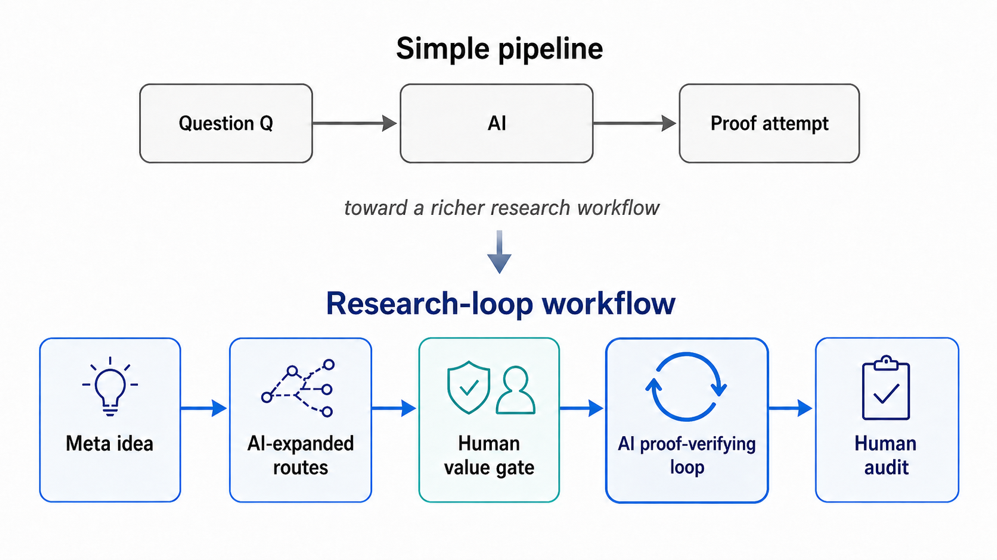
Figure 1: From a fixed-target proof pipeline to a human-gated human-AI research loop.
2. Case Overview: From a Meta-Idea to an Auditable Family of Theorems
This project did not begin with a precisely defined quantum algorithm theorem. It began with a broad intuition from a human researcher: rational approximation is effective for step-type functions, especially the sign function, so could this idea serve as a design principle for quantum algorithms?
In the early exploratory stage, the researcher interacted with general AI models to expand this intuition into a set of candidate research directions and comparison dimensions. The human researcher then used mathematical taste, technical feasibility, and potential contribution as filters, gradually focusing on the sign-embedding route. In later stages, AIM became part of the human-AI research system, helping organize the selected route into auditable theorem targets and derivation materials. The resulting quantum algorithms paper contains 84 pages, and Figure 2 illustrates the role of AI/AIM in its development.
It is worth noting that the early functions supported through general AI dialogue, including route divergence, candidate direction organization, and comparative analysis, have since been further incorporated into AIM v2 as more systematic capabilities. This case therefore shows not only one concrete research process, but also the evolution of AIM from interactive assistance toward support for a fuller scientific workflow.
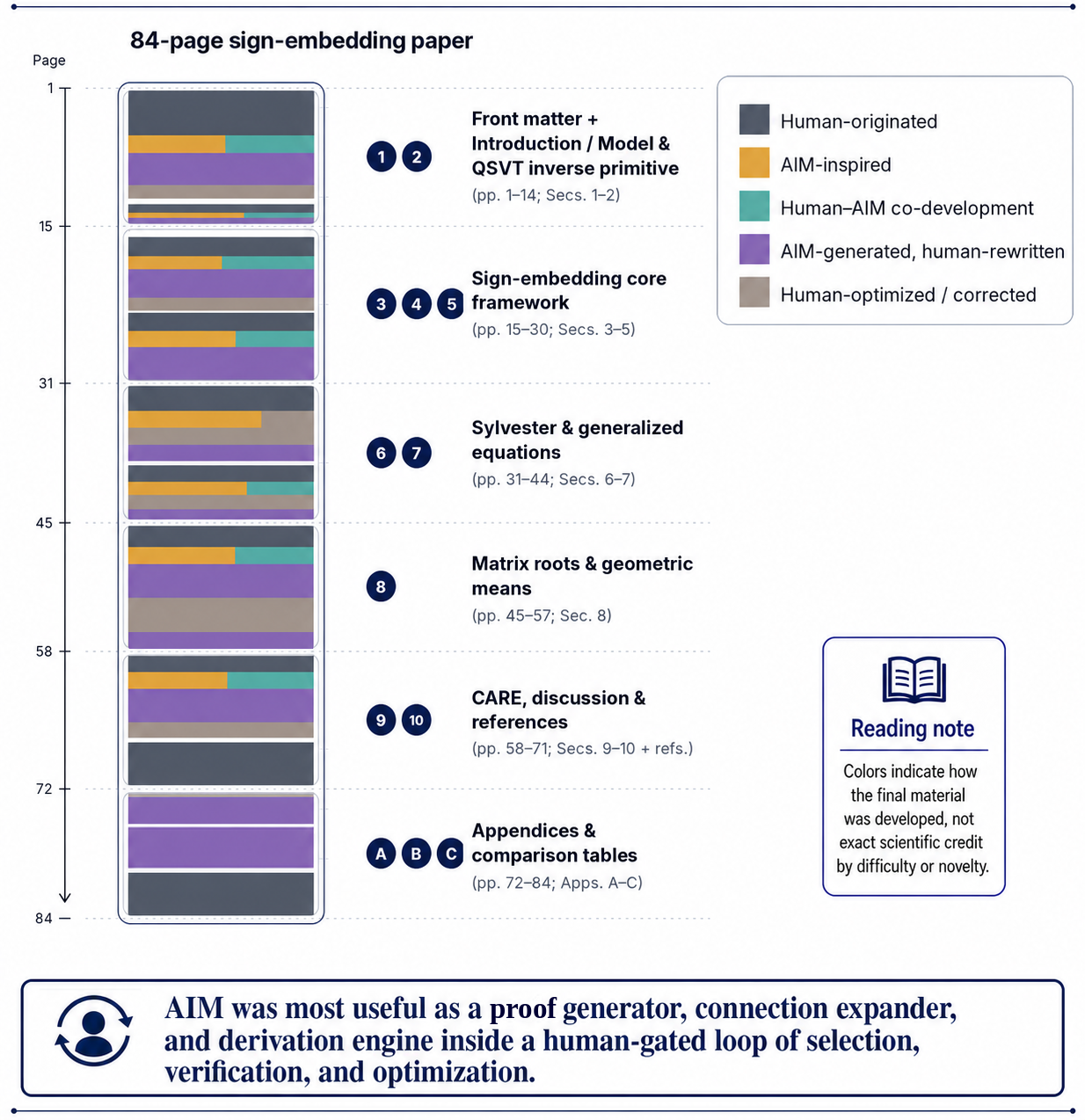
Figure 2: How different parts of the 84-page quantum algorithms paper were formed through human-AI collaboration.
3. Human-AI Workflow: High-Throughput AI Exploration under Human Value Gates
From an AI research perspective, the key point of this case is not to demonstrate fully automated mathematical discovery, but to present a traceable, auditable, and reusable human-AI workflow. The process can be summarized in five stages.
- Divergent Route Expansion: The human researcher provides a core meta-idea or broad scientific intuition. AI expands it into candidate problems, technical routes, and cross-domain connections, helping the researcher see the surrounding research space more quickly.
- Human Value Gate: Faced with AI-generated branches, the human researcher filters and focuses them using academic judgment, problem value, and technical feasibility, deciding which directions deserve further investment.
- Theorem Formation and Derivation: Once the main route is selected, AIM helps turn high-level ideas into theorem statements, lemma decompositions, proof drafts, and complexity expressions that can be audited.
- Complexity Audit and Repair: In quantum algorithm research, a correct proof does not automatically imply a strong algorithmic contribution. Whether assumptions are natural, the access model is reasonable, or the complexity is too loose all require repeated checks. The repair, optimization, and reconstruction process can still use AI/AIM for derivation, comparison, and rewriting, but the key judgments and final confirmation must come from human researchers.
- Validation and Integration: All mathematical statements, proofs, assumptions, complexity estimates, and contribution claims must ultimately be checked, selected, rewritten, and integrated by human researchers before entering a public paper.
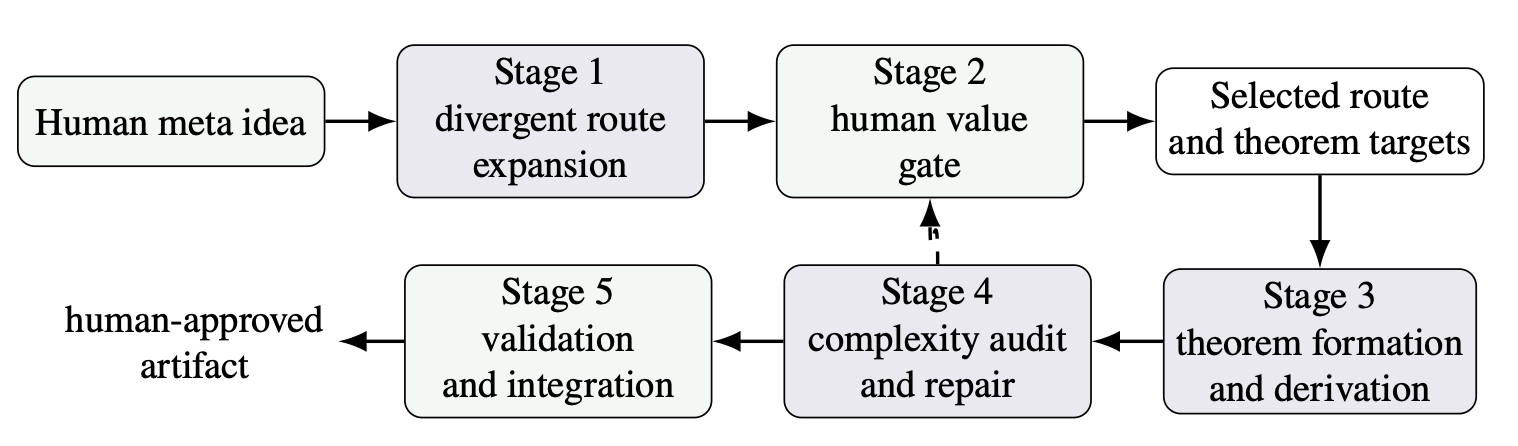
Figure 3: A collaborative workflow that starts from a human meta-idea, expands through AI, passes through human value gates, and produces a research artifact.
4. Methodological Significance: Connecting Discovery, Derivation, and Careful Review
This case shows that AIM’s effective role is not to replace human mathematicians in independently completing research. Instead, AIM improves exploration density and derivation efficiency inside a human-gated loop. AI/AIM can rapidly expand candidate routes, organize connections among related concepts, and generate proof and complexity drafts for review; human researchers decide which routes have research value, which assumptions are acceptable, and which derivations require repair.
This collaboration resembles “high-throughput candidate generation + human value gate + AI-assisted audit and repair + human final integration.” Its advantage is not that AI output can be treated as a final conclusion. Rather, it turns route exploration, connection organization, and local derivation, which are often hard to exhaust manually, into intermediate materials that can be checked, compared, and revised step by step.
For AI4Math and AI Scientist research, this case also suggests that feedback in theoretical research is often not an experimental score but mathematical judgment. Systems need to support long-horizon memory, route management, assumption tracking, complexity auditing, and refutation-oriented checking, so that human researchers can control direction, find errors, and stabilize final results more effectively.
5. Quantum Algorithm Results: A Technical Carrier for the Collaboration
As the technical outcome of this collaborative process, sign-embedding quantum algorithms address a class of matrix equations and matrix functions, including Sylvester, Lyapunov, and Riccati equations, as well as matrix square roots, inverse square roots, and geometric means. These problems are foundational in numerical linear algebra, control theory, dynamical systems, and scientific computing.
For readers outside quantum algorithms, the core idea can be summarized as follows: first compress multiple classes of structured matrix problems into the sign function or sign projection of an expanded matrix, and then realize the corresponding objects using rational approximation and shifted-inverse quantum algorithm primitives. This “embed first, approximate later” route provides a unified organization for several problems that may otherwise look quite different.
The technical contributions of the quantum paper include establishing usable assumptions and complexity statements under more general input conditions such as nonnormal and nondiagonalizable matrices; moving the output form from a single vector state to matrix block-encodings callable by downstream quantum circuits; and developing a more systematic operator-output quantum linear algebra framework through scaling, rebalancing, and complexity auditing at the shifted-inverse implementation layer.
6. Significance and Outlook: Human Judgment and AI Productivity in Theoretical Research
This case presents a realistic way for AI to participate in mathematical research. AI can help researchers expand routes, organize connections, draft proofs, and perform preliminary complexity analysis more quickly, reducing some of the explicit cost of local exploration and foundational derivation. At the same time, whether a research direction is worth pursuing, whether its assumptions are natural, and whether its results have sufficient theoretical value still depend on expert judgment and continuous review.
As agents become able to generate many candidate routes, proof drafts, and technical formulations at high speed, the center of gravity for theoretical scientists may also shift. When part of the cost of routine derivation is compressed, researchers can invest more attention in direction selection, problem definition, assumption gating, and result auditing. In other words, judging what problem is truly worth studying, and identifying routes that appear plausible but hide extra conditions, technical gaps, or insufficient contribution, will become even more important.
This also offers guidance for the future development of AIM. What deserves further strengthening is not only single-step proof or local derivation ability, but also system-level support for the whole research process: recording and comparing different routes, explicitly managing key assumptions, preserving auditable derivation traces, finding hidden conditions and complexity gaps, and helping researchers repair, optimize, and reconstruct results with AI assistance.
This case shows that the value of AI in frontier theoretical research is extending from local task assistance toward fuller research workflows. By organizing route expansion, connection discovery, proof drafting, and audit feedback, AIM helps align AI’s generative and derivational abilities with human direction-setting and mathematical judgment. This collaborative mode opens new possibilities for improving theoretical research efficiency and expanding the researcher’s field of view.
📄 Read the AIM application report: From Meta Idea to Advanced Mathematical Discovery: Human-AI Co-Discovery of Sign-Embedding Quantum Algorithms
📄 Read the quantum algorithms paper: arXiv 2604.25333
💻 AIM repository: TheoryFoundry/AIMv2