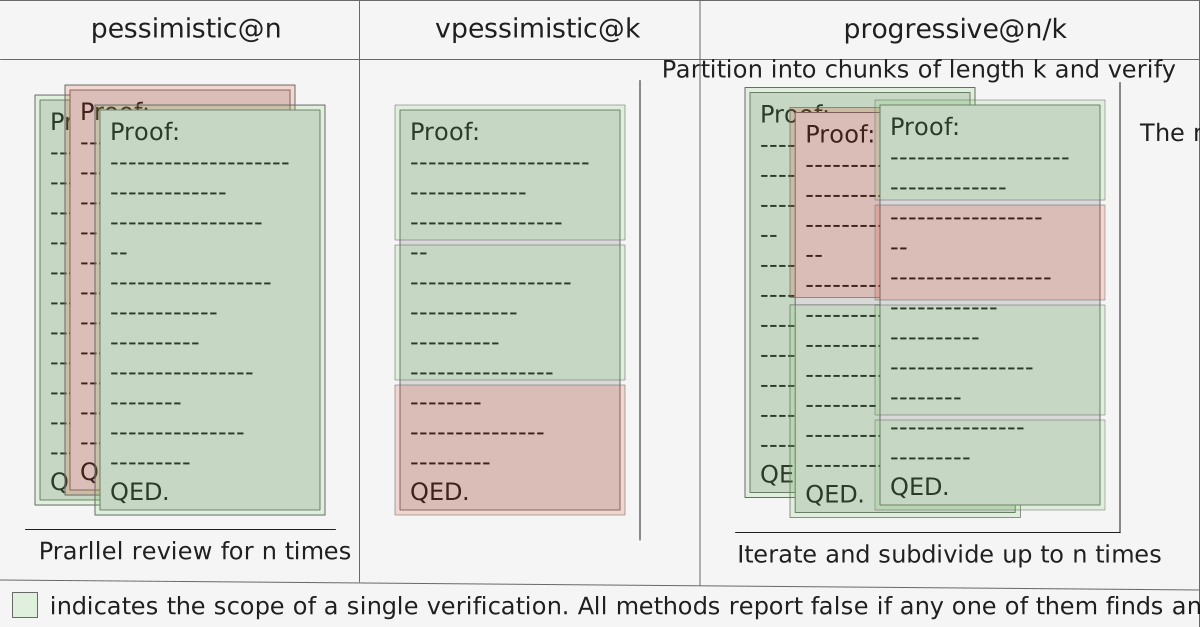
Overview of Pessimistic Verification

Pessimistic Verification: Helping LLMs Check Mathematical Proofs

For mathematical agents, solving problems is only half of the story. They also need to check whether a proof is actually correct. Verification is central to iterative problem-solving workflows and to reinforcement learning for open-ended mathematical reasoning. Our ICML 2026 paper, Pessimistic Verification for Open-Ended Math Questions, studies a simple principle: when verifying a mathematical proof, the bottleneck is usually error detection. Instead of asking multiple reviewers to vote, we ask them to look for flaws. If any reviewer finds a critical error, the proof should be rejected. ...

May 17, 2026

AI Mathematician Helps Solve a Homogenization Theory Problem, Expanding Paths for Mathematical Discovery

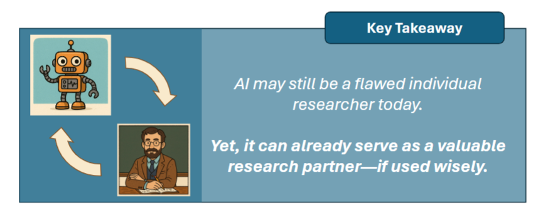
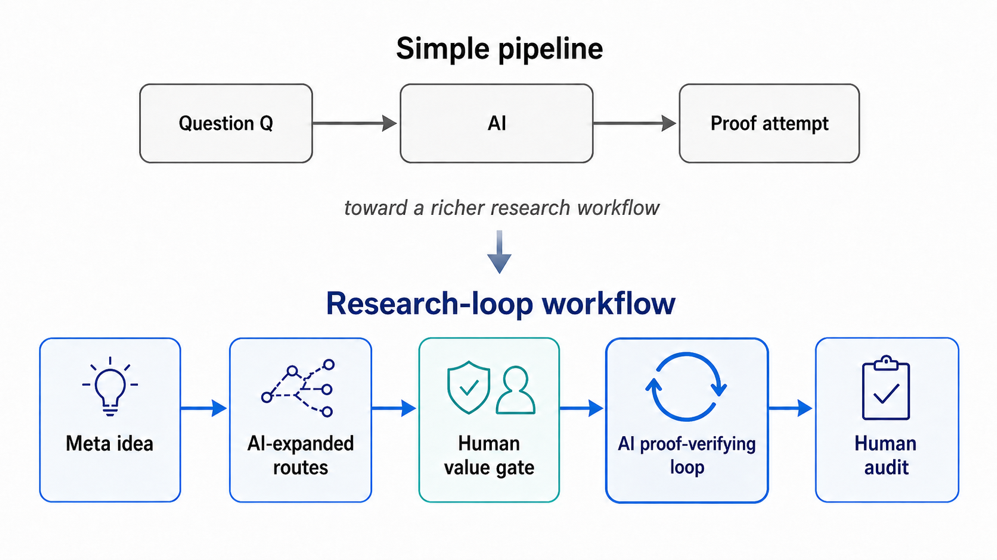
Using the self-developed AI Mathematician system (AIM) as a research collaborator, we successfully solved a challenging problem in homogenization theory through a human–AI collaborative paradigm, resulting in a 17-page mathematical proof. This work systematically verifies the feasibility of upgrading AI from a mere mathematical problem-solving tool to a true research partner, opening a new path for breakthroughs in complex mathematical problems. ...

November 7, 2025
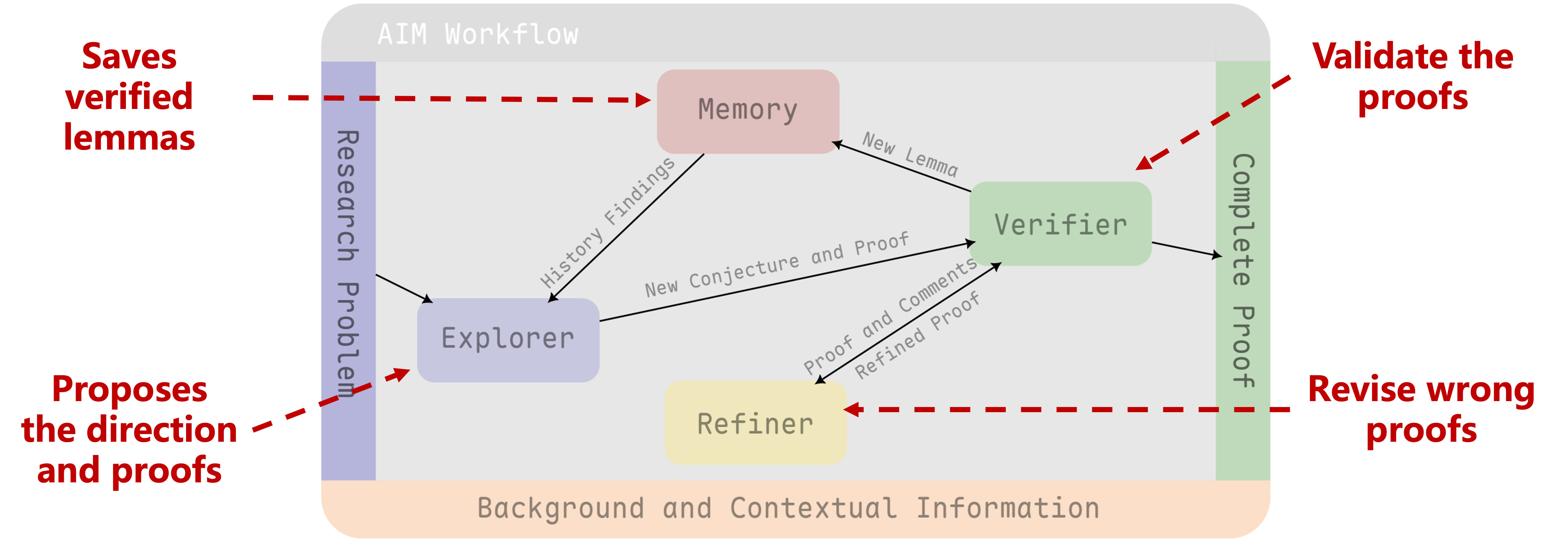
Overview of the AIM Framework

AI Mathematician: Towards Fully Automated Frontier Mathematical Research

Mathematics is the crystallization of human intelligence, occupying a central position in the development of civilization. Using artificial intelligence to solve mathematical problems has long been a dream pursued by scientists. Mathematical problems naturally span multiple levels of difficulty—from elementary to high school, undergraduate, and postgraduate levels, up to professional mathematicians—each requiring progressively deeper knowledge and reasoning capabilities. In recent years, the rapid advancement of large language models, especially Large Reasoning Models (LRMs), has significantly enhanced AI’s capability in mathematical problem-solving. However, most existing studies focus on competition-style problems, with few breakthroughs in systematically addressing research-level mathematical challenges. To bridge this gap, our team proposes the AI mathematician system named AIM—short for AI Mathematician, and also meaning Our AIM is AI Mathematician—which aims to usher AI from solving competition-style problems toward tackling authentic mathematical research questions. ...

June 5, 2025